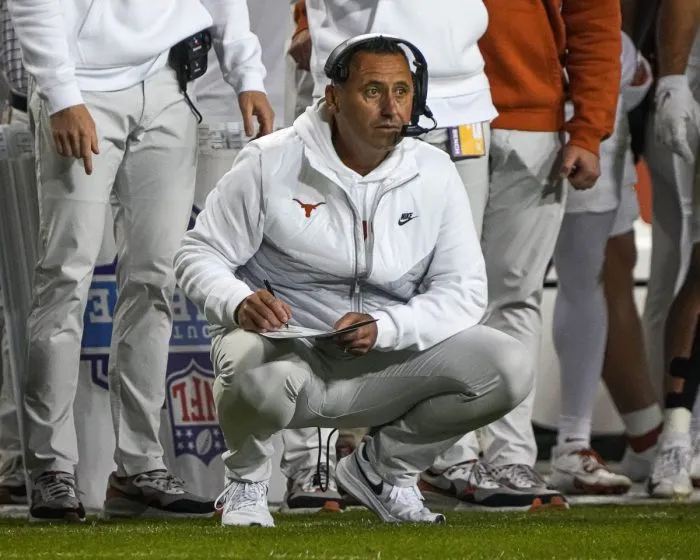
Count Texas football coach Steve Sarkisian as one college football head coach who isn’t a fan of the recent court ruling on Vanderbilt quarterback Diego Pavia’s eligibility.
The decision by the U.S. District Court of Middle Tennessee to grant Pavia another season of eligibility has been the biggest topic of conversation this week in college football. The injunction that Pavia was granted argued the NCAA’s redshirt rule for Junior College or JUCO players violates antitrust laws. As a result, he can play in the 2025 college football season.
“I totally disagree with the…determination on this,” Steve Sarkisian said. “We chose to go to Junior College football. That’s where we wanted to start and play our careers. So, I don’t understand it at all. We’re going to have guys 28-29 years old playing college football. What’s the point? I don’t get it. I don’t understand it. I totally disagree with it.”
Sarkisian is a former JUCO player himself at El Camino College in 1993 and 1994. Pavia began his college career at New Mexico Military Institute where he spent two seasons. He then went to New Mexico State for two seasons before transferring to Vanderbilt for the 2024 season. The 2024 season was his fifth season of eligibility, since he got an extra year due to playing in college during the COVID-shortened 2020 season. However now, Pavia has another year of eligibility, which basically means his time at New Mexico Military Institute didn’t count toward eligibility.
NCAA Responds to Pavia Ruling
“The NCAA is disappointed in today’s ruling and wants all student-athletes to maximize their name, image and likeness potential without depriving future student-athletes of opportunities,” the NCAA said in a statement. “Altering the enforcement of rules overwhelmingly supported by NCAA member schools makes a shifting environment even more unsettled. The NCAA is making changes to deliver more benefits to student-athletes, but a patchwork of state laws and court opinions make clear that partnering with Congress is essential to provide stability for the future of all college athletes.”
The NCAA has the opportunity to challenge the court’s injunction.