What’s going on in the Big 12 and beyond? I expand and explain every Sunday in Postscripts at Heartland College Sports, your home for independent Big 12 coverage.
This week, why is Big Ten commissioner Tony Petitti not living in reality? And, someone should tell Memphis you can’t always get what you want (but points for creativity and I get the intent).
THE MOST ABSURD THING TONY PETITTI SAID
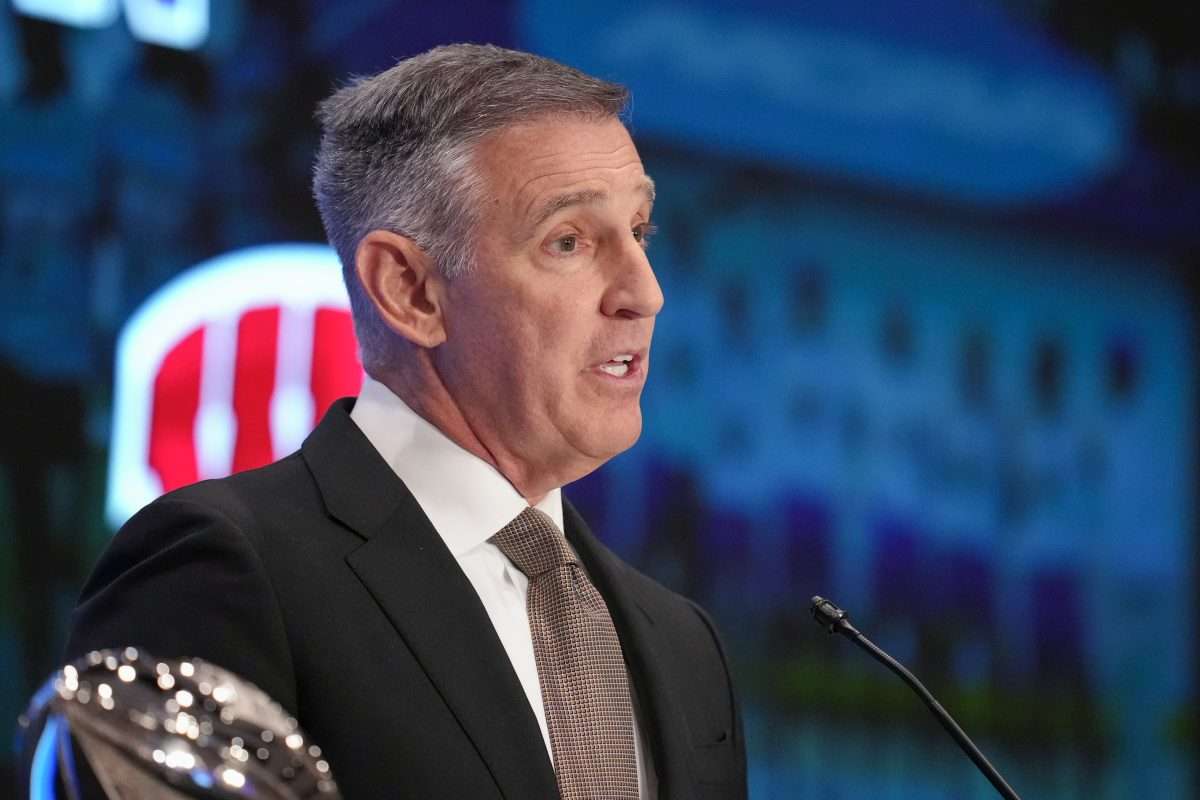
Big Ten Media Days were this week and it’s clear there is some daylight on the College Football Playoff between Big Ten commissioner Tony Petitti and SEC commissioner Greg Sankey. How long that will last is anyone’s guess.
But Petitti made it clear he’s in favor of the 4-4-2-2-whatever model that the two conferences have been supporting for more than a year.
In fact, friend of the Big 12 Stewart Mandel of The Athletic wrote about the week in Las Vegas for Big Ten Media says. He called it “Planet Gaslight.”
Related: CBS Sports Ranks Every Big 12 Coach Ahead of 2025 Season
For years we have accused the SEC of living in its own bubble. It appears the Big Ten has taken up the lease because there was a Stepford Wives-esque alignment between the commissioner and the coaches when it came to messaging around the CFP, scheduling and such.
But here is the most absurd thing he said during his state of the Big Ten address.
“If you are 6-3 in the Big Ten, I would argue that’s a great record,” Petitti said about the CFP. “If you stumbled in a nonconference game, I don’t know why that disqualifies you.”
There are so many ways to pick this idiotic argument apart. Let’s choose three.
So, let’s do the math. Petitti is saying that an 8-4 record — 6-3 in the Big Ten and one loss in non-conference — is good enough to be considered for the CFP. That is, if you’re in the Big Ten.
That’s a .667 winning percentage. In case you’re wondering, that’s Illinois and Iowa last year. Both went 6-3 in the Big Ten last year. Illinois won 10 games, including its bowl game, but was 9-3 after the regular season ended. Iowa won eight games.
Illinois was No. 20 in the final CFP rankings. Iowa wasn’t ranked.
Put another way? Look at last year’s final Top 25 CFP. There isn’t a single eight-win team in the bunch. The committee absolutely doesn’t believe an eight-win team is deserving. Last year the committee didn’t believe a nine-win Alabama team was deserving.
Put a third way? Let’s apply the 4+4 whatever model to last year’s field. Let’s assume the Big Ten gets four bids automatically based on standings. Well, guess what? The same four teams that got in last year — Oregon, Indiana, Penn State and Ohio State — get it. Worst league record? 7-2.
So, no, 6-3 in your conference isn’t good enough to get into the playoff, Tony, and nor should it be. The idea of a college football team that wins 66.7% of its games getting into the playoff is insulting.
Mandel made the point that Petitti is from the professional sports world. Well, kind of. His world is mostly pro sports television. He ran what became CBS Sports Network, the MLB Network and Activision Blizzard. He was the CEO of Major League Baseball for about five years.
I think that’s where this is drawing from. But MLB is totally different. It’s a 162-game, six-month grind in which only six teams from each league make the playoffs. If an MLB teams win 66.7% of its games — the winning percentage for an 8-4 college football season — that team would have won 108 games. That’s usually the best team in baseball. Maybe one or two teams wins 100 games or more in a season.
Petitti’s argument and logic has the heft of flypaper. If I’m Big 12 commissioner Brett Yormark, I keep working Sankey and, at minimum, keep the playoff at 12 if Sankey and Petitti can’t align.
MEMPHIS SHOOTS ITS SHOT
Earlier this week Memphis learned that it would not be joining the Big 12 Conference anytime soon — in spite of its bankroll.
Yahoo Sports and On3 reported earlier in the week that Memphis offered the Big 12 up to $200 million to join the league. Yahoo had the figure at $200 million while On3 had it at $250 million.
The offer, bankrolled by monied boosters including those connected to Memphis-based FedEx, would have brought sponsorship money to the conference, including a sponsorship for the Big 12 football championship game. Memphis would have also surrendered TV money for five years and even given the league an out if the partnership didn’t work.
The Big 12 said no and months of discussions. So … why?
Money talks, right? And that’s a lot of money. But is it? If it’s a five-year deal for $250 million, then spread that among 16 teams and it’s $2 million per schools per year. That assumes the Big 12 doesn’t need any of it for expenses.
Memphis has been considered for the Big 12 before. It didn’t make the cut when the league added BYU, Cincinnati, UCF and Houston.
Per 365 Sports’ David Smoak, there are other reasons Big 12 presidents were reticent to say yes (at least 12 had to).
There were concerns about previous NCAA investigations and the idea of kicking them out if it didn’t work. Plus, it sounds like Memphis might not have even been the first school out when the Big 12 expanded.
Still, Memphis did the right thing. Why? Because the Tigers know what the rest of us know. In 2030, the college sports world is going to change one final time. That’s when the TV contracts for the power conferences come up. There will one last tectonic shift in the sport and then the power leagues and the non-power leagues will be baked in.
Memphis doesn’t want to be on the outside looking it. To the Tigers, any way they can get in now is worth it — even if they must foot the bill.
You can find Matthew Postins on Twitter @PostinsPostcard.