What’s going on in the Big 12 and beyond? I expand and explain every Sunday in Postscripts at Heartland College Sports, your home for independent Big 12 coverage.
Brett Yormark Exits the Big 12
Brett Yormark and I have this odd, unplanned tradition. We always seem to end up on the same flight back to Dallas after Big 12 Basketball Media Days and after the Big 12 Basketball Tournament. We don’t plan it. It just works out that way. After all, there aren’t that many flights between Kansas City and Dallas.
I ran into him again at the airport after Big 12 Media Days a couple of weeks ago. I have a cordial relationship with him. We chatted for about 10 minutes about various things, including the league, and then he got a call from Jim Phillips at the ACC.
There was no hint of what came on Friday.
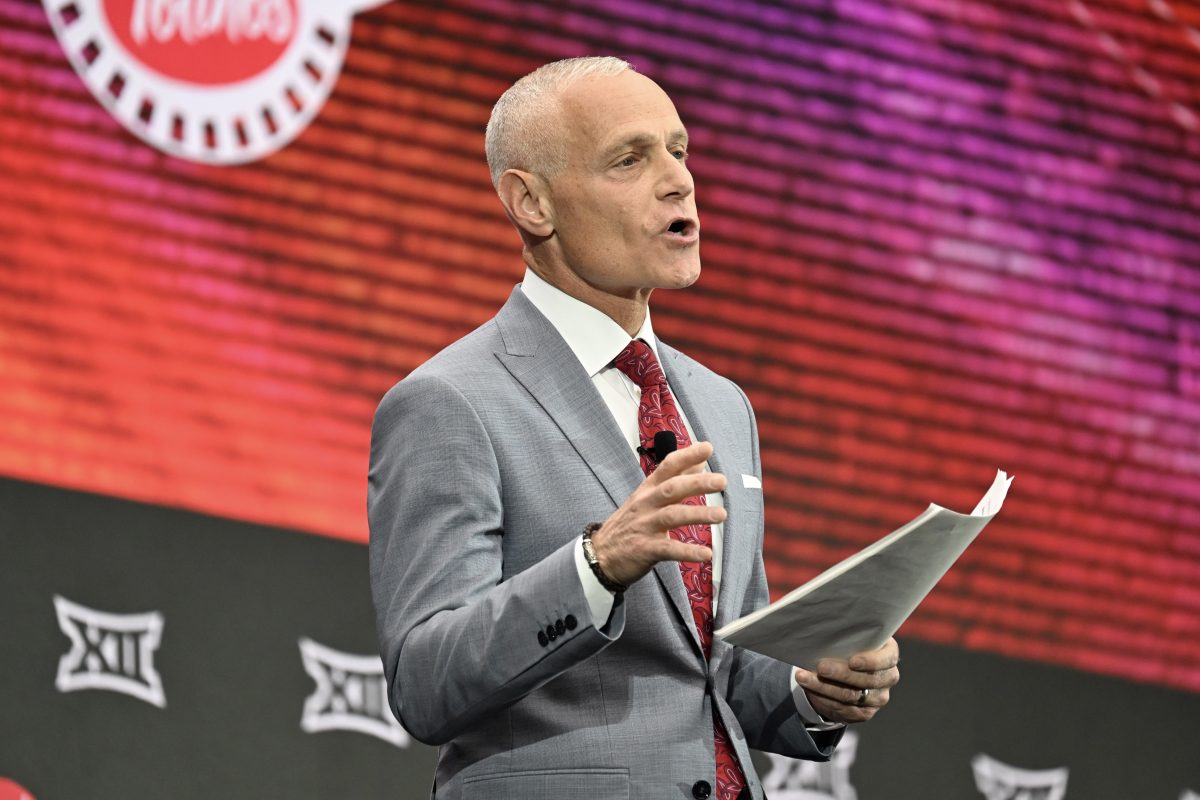
The Big 12 Conference announced that Yormark would be stepping away from the commissioner’s job, most likely at the end of January. The timing was odd. ESPN’s Pete Thamel reported that Yormark and the league had been talking about it only in the past couple of weeks, so someone must have proposed something to Yormark that he was keenly interested in or felt the time was right to leave.
As we’ve learned in more reporting from The Athletic’s Chris Vannini, Yormark was uniquely frustrated with the Big Ten, the SEC and Notre Dame athletic director Pete Bevacqua leading the College Football Playoff TV negotiations and the rest of the commissioners being less involved. I don’t think that was a straw-that-broke-the-camel’s-back moment.
I was never under the illusion this was Yormark’s retirement job. He’s a “doer,” for lack of a better term. Perhaps he felt he had done enough?
It does give us a moment to take stock of his job as commissioner. He was an odd fit for the Big 12. But when you consider the timing and what the conference needed when he took over, he was the right person for the job.
Brett Yormark’s Tenure
He was introduced at Big 12 Football Media Days in 2022 with a resume that didn’t line up with college sports. NASCAR, Brooklyn Sports & Entertainment CEO and the leader of Roc Nation Sports. Outgoing commissioner Bob Bowlsby introduced him.
Most of us didn’t know who he was. There was a thought that he was joining a sinking ship, even as Bowlsby had added four new members in 2021 to help replace Oklahoma and Texas, who were still in the league at the time but preparing for their SEC exit.
That day was marked by one phrase — “The Big 12 is open for business.”
Boy, was it. His first act was his most important one.
When we were at Big 12 Media Days for basketball later that year we started getting hints that the Big 12, ESPN and Fox were working on a new television deal through the 2030-31 athletic year. It was surprising. Not that I didn’t think the Big 12 was going to get a television deal, but that it happened then was surprising. Everyone was wrapped up in what the Pac-12 was trying to do with its television deal.
Within college sports there is an unspoken rule for television deals. Most conferences and most networks don’t want to touch the next deal until the current deal reaches its option period. Yormark jumped the line. In doing so, and in taking a deal that some might see as slightly below market value at the time, he ensured the conference would remain intact through 2030-31. Plus, by negotiating the pro rata agreement, he was able to give any power conference school that needed a place to land somewhere to go.
Did he know the Pac-12 was going to disintegrate? Maybe, maybe not. But then-commissioner George Kliavkoff clearly had no idea which way was up and the Pac-12 presidents were bickering with one another to the point where the dominos fell, Yormark gave the four corners schools a place to land.
Yormark’s directive of being “open for business” has been clear throughout his tenure. Revenue generation is one of the things he does best. At Big 12 Media Days last month he laid all of that out:
“We project our partnership revenue will be up 65% this year. Since 2023, that number has grown by more than 2800%,” he said.
You must have money to compete in college athletics. You can’t argue that he didn’t do that part of the job. He pulled every lever possible, including a private capital deal that gave the membership access to a line of credit if needed. While no one took him up on the offer, it did cement a partnership with two of the biggest private capital firms in the country for more revenue generation. That was really the point.
The Big 12’s leadership understood that revenue generation was going to help them bridge some of the gap with the SEC and the Big Ten. That was a big reason he was hired. The powers-that-be back then made it clear — they knew he was different but that was what they wanted. This is the guy who helped negotiate NASCAR’s Nextel deal, which at the time was the industry standard for a league sponsorship.
Not everything he did worked. He’s always struck me as a “halt and catch fire” kind of innovator. He wasn’t afraid to break a few eggs. He’s even said several times, “progress over perfection.”
The ABS GlassFloor was a great example. That technology might be more ubiquitous in five years. But the rollout was faulty. Going to a floor that had barely been used by the league’s members six weeks before the league’s signature basketball tournament invited blowback and the league got it, to the point where it was switched out halfway through the men’s tournament. That should have been a 2027 proposal to give everyone more vetting time. It felt rushed.
He was ripped for the Monster deal and some of it was justified. It was a first-of-its-kind deal, and it shouldn’t be compared to a school jersey patch deals because schools will always get more for their brand than a conference. What the Big 12 didn’t have was a proper valuation because it had never been done before. The Big 12 should have gotten more in return. Given more time, perhaps it will. I think that’s what Yormark was hoping. At least the deal is only for two years.
He also signed away some of the power he needed to direct the CFP away to the SEC and Big Ten with the memorandum of understanding in 2024. But he wasn’t the only one. Seven other commissioners did that, fearing the SEC and Big Ten would break away. They still might someday.
I never asked Yormark what frustrated him about the job. But I imagine that one thing that did was the pace and decision-making. Running the Big 12 is not like his other jobs. He was in charge. He made decisions and they were executed on his terms. A conference commissioner must build consensus and can’t execute decisions unless the vast majority agree. That takes time. Remember — he’s a “doer.”
Yormark experienced that several times. He had high basketball ambitions for the league, many of which I liked — I am the basketball guy here at Heartland, after all — including adding UConn and Gonzaga. But the league’s board of directors couldn’t get past UConn’s football program and the fact that Gonzaga was in Washington state. To build his vision for a basketball-only television contract he needed more brands and those were two of the best. The board of directors disagreed. Yormark had to live with that. If that frustrated Yormark, that’s understandable. But that’s also the job.
As incredible as the changes have been in college athletics the past five or six years, decisions still get made glacially. We’ve been talking about legislation for NIL for five years, and the bill that’s in the U.S. Congress might still die in the U.S. House. I think Yormark likes to work at a faster pace, one faster than most university presidents are used to.
I know some people who love what Yormark has done and others that don’t care for him (looking at you, Texas Tech). That’s life being in charge. You’ll never be loved 100% of the time. Yormark seemed at peace with that. You have to be in this job.
Yormark joined the Big 12 at a time when they needed somebody who was willing to break a few eggs, and perhaps that’s his greatest asset: his ability to just say, “Let’s do something and see if it works.” If the Big 12 was a laboratory, then he was the chief scientist, and many of the things conceived during his time with the Big 12 worked.
At the end of the day, the Big 12 is in a far better position now than it was when he took over. There were still legitimate concerns back then that the Big 12 might not make it to the next TV deal. Now, the conference has some security through 2031. That decision to go after the TV deal when he did more than any other will be his legacy as Big 12 commissioner.
If we’re grading him out, I give him rock-solid B. Most of what he was asked to do, he did. The conference is on much better footing than it was four years ago. Wherever he ends up, wherever he lands, whatever he does next, it should be fun to follow.
The next commissioner inherits a much better Big 12 than the one Yormark inherited. That’s worthy of respect. Or would you rather be settling for less than $10 million per year in a Group of 6 conference?
Didn’t think so.
<iframe src=”https://app.e2ma.net/app2/audience/signup/2098245/1964875/” width=”510″ height=”500″ frameborder=”0″></iframe>