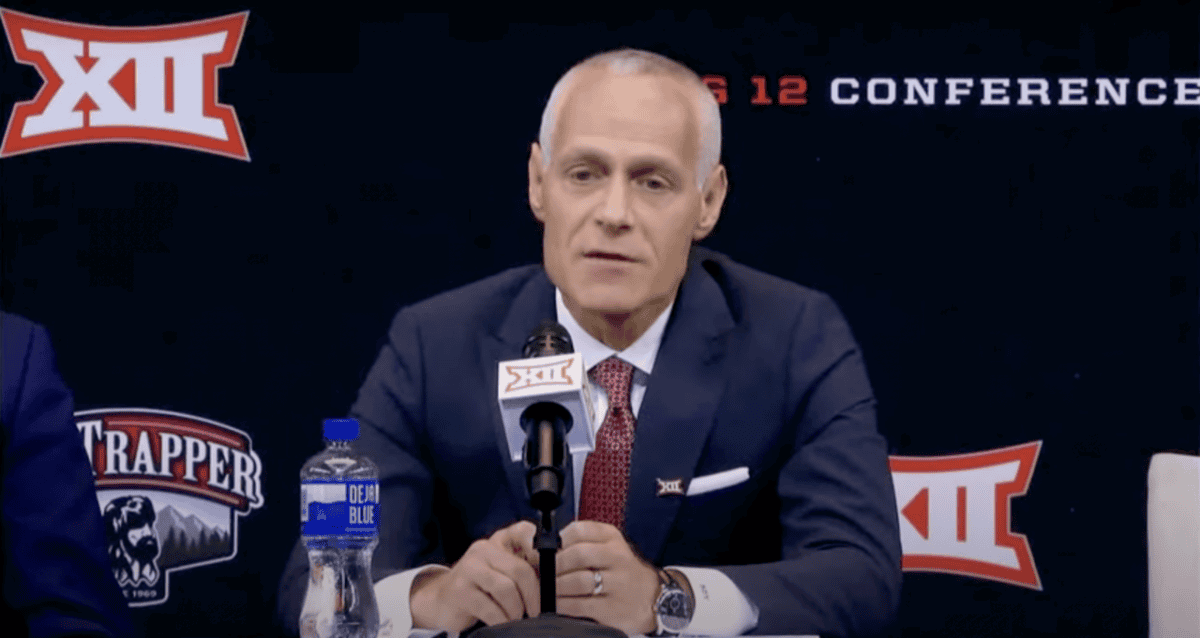
KANSAS CITY, Mo. — Big 12 Commissioner Brett Yormark said the conference is “doubling down” on growth as he spoke at Big 12 basketball media days on Tuesday. He wasn’t talking about conference expansion. He noted that the league has expanded by eight teams in the past few years and is happy with the membership. The growth is more about revenue, expanding opportunity for his schools and their student-athletes. He expressed his support for the 24-team College Football Playoff proposal on the table and the expanded NCAA Tournament, saying he hopes to get at least 10 teams in both the men’s and women’s tournaments this year.
Here are three of the most important things he said on Tuesday.
The Big 12 Championship Game
Nothing is final with the College Football Playoff. But if the proposed format gets to the finish line, that will eliminate the Big 12 Championship game for football, which has been a revenue driver for the league and was a sellout last year when Texas Tech beat BYU.
Yormark was asked about the possibility, along with the potential for, perhaps, other significant league events like the Big 12 men’s and women’s basketball tournaments going away due to expansion in other areas.
He said if those must go away, they’ll find other tentpole events to build around.
“We’re in the event business,” Yormark said. “It drives a lot of fan engagement and excitement. So, we’ll see what happens in the future. But those are big moments for us. And for some reason, if one goes away, we’ll replace it with something different.”
Non-Conference Scheduling
The Big 12 requires all its teams to play a power conference opponent in non-conference. A few have struggled to get that game, including Texas Tech, which saw a neutral-site series with USC fall apart earlier this season. Yormark was in Provo for the BYU-Notre Dame showdown on Saturday and said the atmosphere was incredible.
Big 12 teams have lost several home-and-home series contests with SEC schools, in part because the SEC adopted the same nine-game schedule format the Big 12 uses. The SEC also required a non-conference power conference contest.
If the CFP reaches the finish line, then all power conference teams will have to schedule a non-conference power conference game each year. Yormark sees bigger games like that in the Big 12’s future in that case.
“Our schools are committed to playing the biggest and best, and I do believe that if we were to get something done with the CFP and expand to 24, you’ll see scheduling the scheduling dynamic move in a different direction, and I think that’ll be a positive when you think about scheduling and the best matchups week in and week out, specifically out of conference,” he said.
Protect College Sports Act
Yormark fielded several questions around the legislation, which was passed in the U.S. Senate before its recess and will head to the U.S. House after the midterm elections. It’s not clear if the legislation will pass the House, but he said he’s part of four working groups trying to keep the legislation moving.
He was asked about how much student-athletes have been involved in the discussions about the legislation.
“I can tell you that I sit on four of the committees, the president’s committee commission on college athletics, and there has been great representation by student athletes on all those committees, and they’ve had a voice,” Yormark said.
One of the parts of the legislation that student-athletes are likely to take some issue with is the one-time transfer rule, which the NCAA implemented several years ago but was overturned in court cases. Student-athletes can now transfer year-to-year, if they wish. A group of student-athletes are also in court in attempts to be eligible this season, most of which were Class of 2022 athletes who did not redshirt and are not getting a fifth year to play based on the NCAA’s new age-based eligibility rule.
Yormark said he supports the age-based eligibility rule, which gives student-athletes to play five years of college athletics.