Could Midweek Big 12 Football Games Be a Staple in 2024 and Beyond?


During the 2023 Big 12 Football Media Days, commissioner Brett Yormark floated the idea of the league looking into the possibility of playing more Thursday and Friday “midweek” games in order to further exposure to the Big 12 brand.
An innovative and outside-the-box thinker, Yormark has made it a point to make sure that his league is doing everything that it can to be the first conference in mind when it comes to groundbreaking ideas.
“When you think about the tonnage of college football on air on a Saturday, it provides a lot of opportunity for us to kind of build our profile on a Friday night,” Yormark said.
So, could we see midweek games become a future staple in the Big 12 football scheduling model?
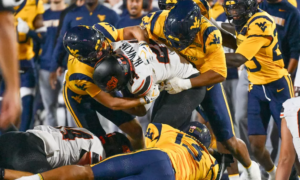
West Virginia head coach Neal Brown showed support for the idea at Media Days as well, pointing to the ratings that the Mountaineers had in three midweek games during the 2022 season.
“I’m a fan of the midweek games if we can make it work,” Brown said. “We played three midweek games last year. Go back and look at the TV ratings on all three of those games. Extremely high. What happens when you play a midweek game is you’re only competing maybe against one other team.”
As we head into the 2024 offseason and begin to prepare for a new-look 16-team Big 12, it’s due time that we assess the changes that are coming to the league and how the powers that be can make the most of the new opportunities.
Despite some of the challenges that midweek games bring to the table, there’s a chance that the pros could outweigh the cons. Let’s take a look at some contributing factors.
Increased Inventory
The first change that is worth noting is what adding two more total schools does to the weekly schedule. In a league that plays nine conference games, each team will play three nonconference opponents. That’s 48 nonconference games in the first three to four weeks. Now, that might not sound like a lot at first, but when you consider the Big 12 was just scheduling 30 such games just two seasons ago, it’s pretty clear how much larger a task that is for scheduling.
Now let’s look at the conference slate. There were 45 Big 12 games in 2022, but that moved to 63 Big 12 games last season with 14 teams, and there will now be 72 Big 12 games in 2024 when the league reaches its 16-team mark. That is a ton of inventory to fit into three-hour television windows on Saturdays, especially when some of those games would be forced to compete against one another.
The 2024 Calendar
The 2024 calendar will actually play a role in midweek games as it sets up for the majority of FBS teams to have not one, but two bye weeks.
NCAA Bylaw 17.11.4 states, “An institution shall not play its first contest (game or scrimmage) with outside competition in football prior to the Thursday preceding Labor Day.”
With Labor Day falling on September 2, 2024, FBS teams will be permitted to begin their season on Thursday, August 29, with most teams kicking things off on Saturday, August 31.
Between Labor Day and Thanksgiving Weekend, there are 14 Saturdays for FBS programs to fit their 12-game schedules into, leaving each team with two bye weeks. There are, of course, exceptions to the Labor Day rule with games in Hawaii, Week 0 games in foreign countries, etc. However, for the Big 12 schedule, there are 14 Saturdays to work with.
Decreased Competition
The vast majority of college football games have always been, and will always be played on Saturdays, as they should be. However, there is a market out there for teams to play on Thursday and Friday as well, and the Big 12 could be the league to fill that void.
We’ve seen conferences like the Pac-12 select a game for a late evening kick on Friday nights, and those games typically performed well. Now, the Pac-12 won’t be around to fill those windows, and it’s unlikely that the Big Ten is going to keep brands like Washington or Oregon off the screen on Saturdays during primetime.
Plus, the NFL has moved Thursday Night Football exclusively to Amazon’s Prime TV, which not everyone has a subscription to, or the desire to watch football on a streaming platform. That alone knocks off a ton of competition for viewership as football fans start to get ramped up for the weekend.
That makes the Thursday and Friday evening time slots a perfect place for the Big 12 to attack going forward.
Increased Ratings
As Neal Brown pointed out back in July, the ratings for midweek games are typically very good for the teams involved. In 2023, the Big 12 played a total of nine “midweek” games, and several of those game performed exceedingly well.
In Week 2, Kansas vs. Illinois was the third-highest-rated Big 12 game of the week with a 0.7 rating and 1.36M viewers, trailing only Texas vs. Alabama (8.76M), and Oregon vs. Texas Tech (2.55M).
In Week 5, Cincinnati vs. BYU was the second-highest-rated Big 12 game of the week with a 0.7 rating and 1.23M viewers, trailing only Kansas vs. Texas (3.32M).
In Week 6, Kansas State vs. Oklahoma State was the second-highest-rated game of the week with a 1.3 rating and 2.27M viewers, trailing only Oklahoma vs. Texas (7.87M).
In Week 13, Texas Tech vs. Texas was the highest-rated game of the week with a 1.8 rating and 3.77M viewers. Oklahoma vs. TCU was the fourth-highest-rated with a rating of 1.2 and 2.22M, trailing TTU-UT, BYU vs. Oklahoma State (2.39M), and Iowa State vs. Kansas State (3.29M).
(All ratings data collected from Sports Media Watch)
Supply and Demand
It’s no secret that football fans can and will watch football, regardless of what day of the week it’s on.
With Monday Night Football (NFL), MACtion on Tuesday and Wednesday, Thursday Night Football (NFL) and midweek FBS games on Thursday and Friday, College Football Saturday, and NFL Sunday, there was a stretch in October-November this past season with live football on television for 27 consecutive days.
The demand is there, and with the Big 12 set up to cover almost every time zone available, there’s no shortage to what the conference can provide.
With brands like Utah, Colorado, BYU, and the Arizona schools out West, plus West Virginia, UCF, and Cincinnati serving the East Coast, there’s a chance to fill Thursday and Friday nights with Big 12 logos, and still have plenty of inventory to provide a full slate of action on Saturdays.
Conclusion
The idea has been floated and the opportunity is there. With Brett Yormark being the forward-thinker that he is, I’d be shocked if the Big 12 doesn’t take a chance on putting some of its games out there in the midweek to see if they can eat up the majority of those late-night football fans.
The precedent is there too, with some matchups greatly exceeding the numbers that they’d have gotten in a crowded window on Saturday. Imagine what the numbers might look like if the Big 12 were to get a ranked-vs-ranked matchup between Utah and Oklahoma State on a Friday night? Ratings for something like that might go through the roof.
We won’t have to wait long to see how things play out either, as the Big 12 schedule is expected to be dropped on Tuesday.
Will there be more midweek games on the docket? While I’m typically not a proponent of college football being played on any other day but Saturday, in this case, I certainly hope so.