What’s going on in the Big 12 and beyond? I expand and explain every Sunday in Postscripts at Heartland College Sports, your home for independent Big 12 coverage.
The Big 12 Basketball Scheduling Note Worth Monitoring
No Big 12 men’s basketball teams have control over their conference schedule, which is 18 games. But with an expanded non-conference schedule, there is more control over the 14 games they can schedule.
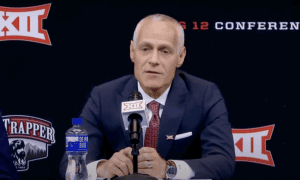
Big 12 president of basketball operations Brian Thornton would like his teams to be more judicious about those 14 games, especially the “buy games” that every team plays.
Those “buy games” help Big 12 teams get more home games. They offer a piece of the gate to mid-major and low-major teams to come play them at their place. Some of those mid-major teams would rather get a home-and-home out of the arrangement. I’ve had Big 12 coaches tell me they’d rather play quality mid-major teams on neutral sites to have more give when it comes to NET ratings, which is the primary tool the NCAA Tournament uses for selection.
But two developments have caused Thornton to lean into his coaches and teams to schedule with a bit more difficulty in non-conference, per an expansive piece at CBS Sports. The first is the expansion of the NCAA Tournament. The second is the wise of the WAB.
Look — no one wanted the NCAA Tournament to expand outside of those that make money on the event. But it’s here and the Big 12 sees a chance to get more teams in the tournament. The Big 12 has never gotten more than eight teams in the field. The league had a pair of bubble teams that fell short last year and an expanded field they might get in. So how does the league get them in? Or at least convince its members to schedule a little tougher with those 14 games?
What is WAB? Wins Above Bubble
Thornton told CBS Sports that he believes WAB, or wins above bubble, is the right tool for the Big 12 programs to look at.
What is WAB? This is also an NCAA analytic that the committee is giving increasing value to. CBS Sports explained it rather succinctly:
“WAB is an analytic that values a team’s wins against its schedule and mathematically deduces how well its done vs. how an average bubble team in that same season would have performed against the same schedule. It does not take margin of victory/defeat into account and is now regarded as one of the three most important metrics on a team’s NCAA Tournament résumé.”
So if it’s that important, then the Big 12 coaches and schedule-makers need to value it too, right? That’s the point Thornton has been making this offseason, to the point that he brought ESPN bracketologist Joe Lunardi to speak to them at Big 12 meetings and has offered case studies on how WAB can impact a team’s chances of getting in.
If you look at the eight Big 12 teams that got into last year’s NCAA Tournament the team with the lowest WAB was UCF, which was ranked No. 42 at 1.41. The Knights were an at-large team. The first Big 12 team to miss the field per WAB was No. 50 West Virginia (-0.92), followed by No. 54 Arizona State (-1.06) and No. 60 Oklahoma State (-1.42)
If we’re applying this to an expanded field, then WVU would have been in play for a bid. Arizona State and Oklahoma State would have had cases. They were all in the mix down the stretch, but TCU was the team that rose above them to make the field. The Horned Frogs were No. 31 in WAB at 2.72.
So how does Thornton think the Big 12 can get there? He wants them to schedule a bit harder in non-conference. He told CBS he wants them to eliminate games against the bottom 100 teams in NET (or Nos. 265-365).
“If you want to increase that WAB number, you need to have more teams in the 200 NET instead of 300 NET,” Thornton told CBS. “Almost getting rid of Quad 5 games, so to speak.”
So, who took the hint? I checked four schedules — two of last year’s bubble teams and two of last year’s top teams — to see if they applied the advice.
Oklahoma State has scheduled five high-major opponents along with two quality mid-majors at home in Grand Canyon and Saint Mary’s. Of the Cowboys’ remaining seven non-conference games, two feature teams with a 300 NET or worse and two others are in that bottom 100 of NET from a year ago.
How about West Virginia? The Mountaineers have seven potential high-major games, including their trip to the Players Era (which could include a game against Kansas). Of the remaining games, five had a NET of 300 or worse last season.
Houston is a contender to win the Big 12. Where are the Cougars? Houston has seven power conference opponents. Of the other seven, none had a NET of 300 or worse last year and none fall in that last 100 Thornton talked about.
Iowa State is a team that gets plenty of flak for its non-conference schedule. So, let’s take a look. The Cyclones only have four high majors — and could get a fifth if it reaches the Players Era title game. ISU gets San Diego State and Memphis at neutral sites, two quality mid-majors. However, five other non-conference opponents had a NET of 300 or worse last year. Another falls into that bottom 100.
You could argue that if things go the way most expect, the Cougars and Cyclones won’t need as much help as the Cowboys and the Mountaineers. Will OSU scheduling just two teams with NETs of 300 or worse and the Mountaineers scheduling five in that same category make a different if both end up on the bubble, as they did last year?
The results could be instructive in an expanded field where Thornton’s experience is telling him to advise his teams to focus on certain things in scheduling for the 14 games they can control.